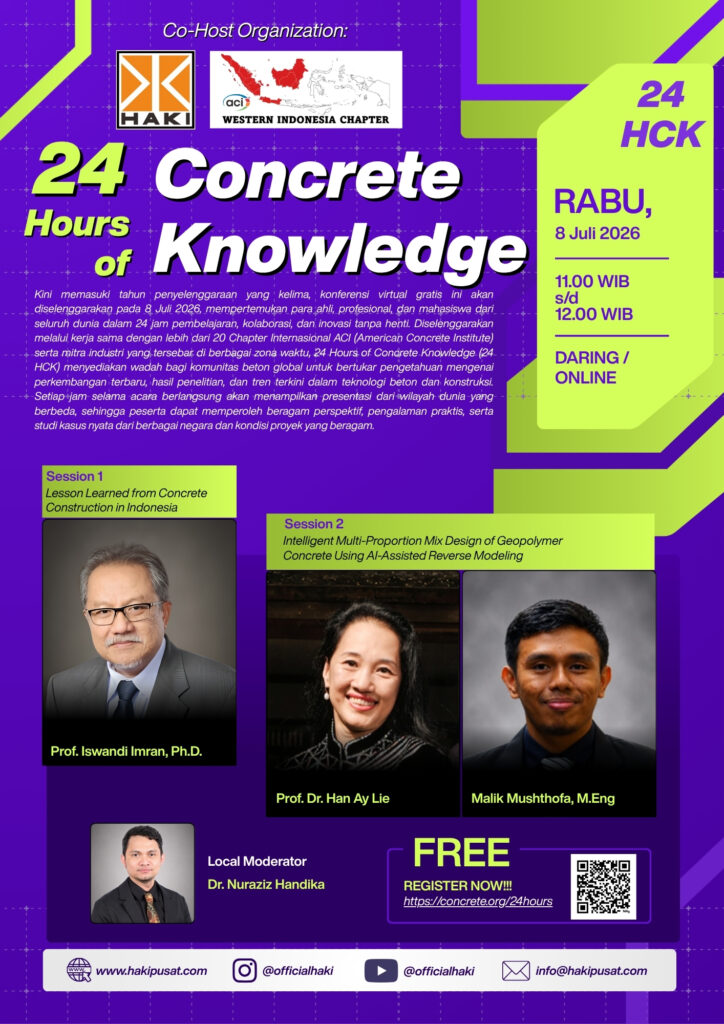
24 Hours of Concrete Knowledge
Session 1: Lesson Learned from Concrete Construction in Indonesia

Prof. Iswandi Imran, Ph.D.
Presentation Title:
Lesson Learned from Concrete Construction in Indonesia
Abstract:
Concrete construction plays a vital role in the development of infrastructure and buildings in Indonesia. However, various quality-related problems are still frequently encountered during construction activities in the field. This presentation will discuss lessons learned from concrete construction practices in Indonesia by highlighting common defects and failures observed in concrete works, such as low concrete strength, honeycombs, cracks, cold joints, segregation, and other workmanship-related issues. These problems often lead to reduced structural performance, increased repair costs, project delays, and long-term durability concerns.
The presentation will also discuss the root causes associated with these concrete defects. Factors such as inadequate material control, improper mix design, poor workmanship, insufficient supervision, unfavourable environmental conditions, lack of proper curing, inadequate compaction, and non-compliance with construction procedures are identified as major contributors to the occurrence of defects in concrete structures in Indonesia.
Several initiatives to improve the competency of the Indonesian construction industry will also be discussed in this presentation to prevent similar problems from recurring in future projects. These efforts include enhancing workforce training and certification and adopting more advanced construction technologies and methods.
These lessons learned are expected to contribute to better quality control practices, enhanced durability of concrete structures, and more sustainable construction implementation in Indonesia.
Session 2: Intelligent Multi-Proportion Mix Design of Geopolymer Concrete Using AI-Assisted Reverse Modeling

Prof. Dr. Han Ay Lie

Malik Mushthofa, M.Eng
Presentation Title:
Intelligent Multi-Proportion Mix Design of Geopolymer Concrete Using AI-Assisted Reverse Modeling
Abstract:
The increasing use of Portland Cement has raised environmental concerns, emphasizing the need for sustainable alternatives in concrete production. Fly ash-based geopolymer concrete (FABGC), in which fly ash combined with alkaline activator serves as the binder, offers a promising eco-friendly substitute. This approach reduces carbon emissions and repurposes industrial waste (particularly fly ash), which availability is expected to increase through 2050. However, a universally accepted mix design formula for FABGC has not yet been developed and the method applied is by trial-and-error. This study aims to establish a multi-proportion mix design framework for FABGC that allows users to obtain customizable proportions for specific target strengths.
Several hybrid artificial intelligence (AI) models with hyperparameter tuning were developed and evaluated using multiple error metrics. The models were trained and validated using 10-fold cross-validation with an 80:20 train-test data split. The Particle Swarm Optimization (PSO) algorithm was employed to reverse the trained AI model, to generate multiple feasible mix proportions corresponding to a desired target strength.
Among the developed models, the Gradient Boosting (GB) model demonstrated stable and consistent performance during training, validation, and testing, achieving R2 values of 0.975, 0.877, and 0.900, respectively. The reversed AI model successfully generated multiple feasible mix proportions for a certain target strength with varying alkaline activator solutions-to-fly ash ratio (AAS/FA) at different NaOH molarities. By providing multiple proportions of a given target strength, the proposed system offers greater flexibility to the users. Furthermore, it supports sustainable construction practices by incorporating the embodied carbon footprint calculations and ensuring the workability through slump value estimates for each generated mixture proportion.
Moderator:

Dr. Nuraziz Handika